Category: Uncategorized

  • Napkin Materials Explained: Tissue Ply, Airlaid, and Linen-Feel

    Napkin Materials Explained: Tissue Ply, Airlaid, and Linen-Feel

    What a napkin is made of decides how it feels, how much liquid it holds, and what it costs — far more than the logo printed on it. Two families cover almost every custom order: conventional tissue, the familiar soft paper napkin, and airlaid, a heavier nonwoven engineered to feel like cloth. Knowing how each one is built, and where cloth still wins, is what keeps you from overpaying for a bar napkin or under-buying for a plated dinner.

    Tissue napkins: how ply and weight really work

    A tissue napkin is made by forming and creping thin sheets of paper, then bonding them in layers called plies. A single-ply beverage napkin is light and inexpensive; two- and three-ply napkins stack more sheets for extra thickness, softness, and absorbency. Standard tissue napkins land in a fairly narrow band of material weight, roughly 10 to 35 grams per square meter across the common grades, and within that range there is a real trade-off: softness and strength pull against each other, so the softest, most luxurious-feeling tissue is also the quickest to shred when it gets wet or is tugged across a plate.

    Size tracks use rather than material. Beverage or cocktail napkins are about 10 inches square, snack napkins around 12, luncheon napkins about 13, and dinner napkins 16 inches square, folding down to fit the place setting. Choosing ply is really about how much work the napkin has to do: light finger food forgives a single ply, while a messy plated meal wants the extra absorbency of two or three.

    Fold and packaging matter as much as raw size once the napkin reaches the table. The same dinner napkin can arrive as a simple quarter-fold, an eighth or book fold that presents a clean panel for a printed logo, or an interfold made to feed one at a time from a dispenser. A dispenser-grade napkin has to match the dispenser’s throat to feed without jamming, so if you are buying for a countertop or wall unit, confirm the fold and opening before you lock in the stock, because a handsome napkin that will not dispense becomes a daily headache.
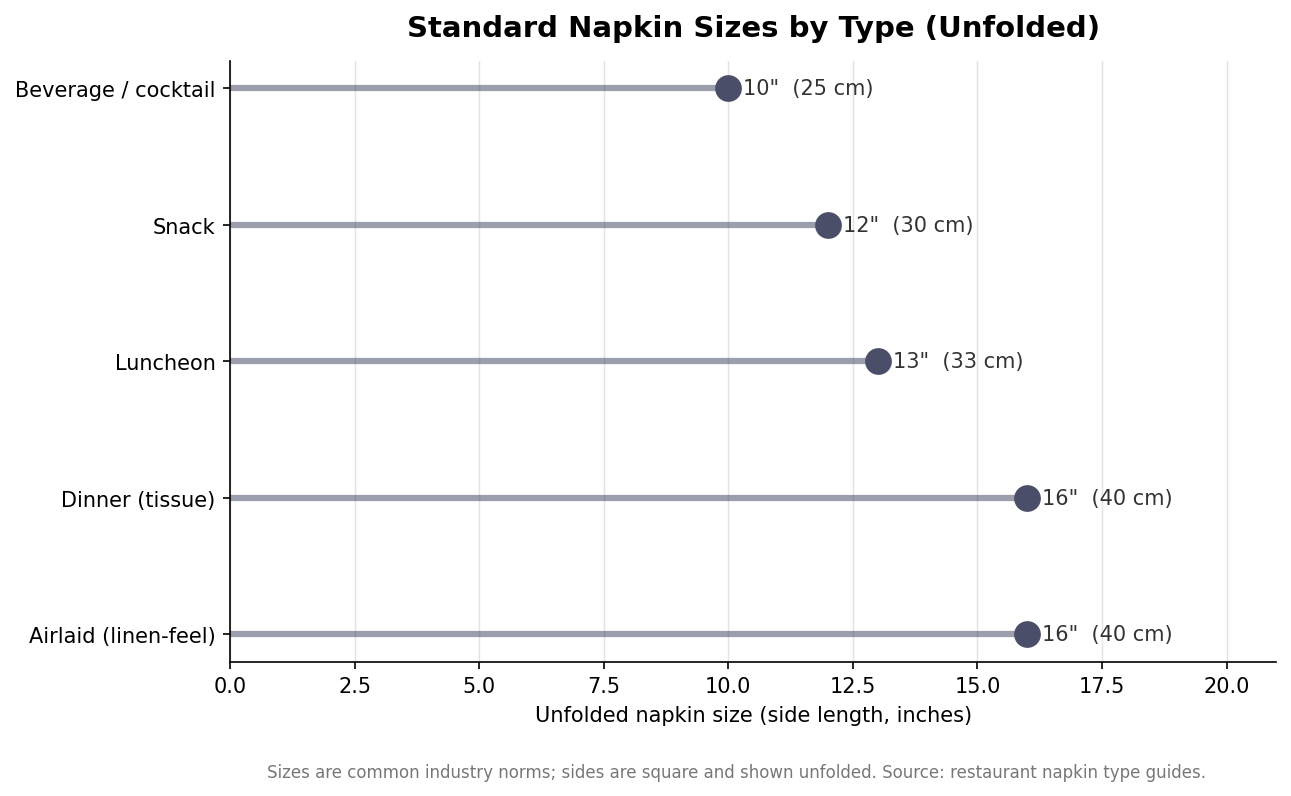
    Lollipop chart of unfolded napkin side length in inches and centimeters for beverage, snack, luncheon, dinner, and airlaid napkins
    Standard unfolded napkin sizes by type, from 10-inch beverage to 16-inch dinner and airlaid.

    Airlaid: the linen-feel disposable

    Airlaid is a different material, not just a heavier tissue. It is a lofty nonwoven made mostly from fluff pulp, formed by dispersing the fibers in air rather than water, which produces a thicker, softer, more absorbent sheet with a distinctly cloth-like hand. In practical terms a single-ply airlaid napkin behaves like a piece of light fabric: it stays strong when wet, resists linting, and drapes rather than crumples. That construction is why upscale restaurants and wedding planners reach for it when a paper napkin would undercut the table.

    The weight difference is the clearest way to see the gap. Where standard tissue sits between roughly 10 and 35 grams per square meter, a typical airlaid dinner napkin runs closer to 50 to 60, roughly double the substance in a single layer. That heft is what carries embossing and foil crisply and what lets a guest actually use the napkin without it disintegrating. Airlaid also takes deep, saturated dye and holds an emboss without flattening, so a solid-color airlaid in a brand shade reads richer than the same color printed onto thin tissue. It costs more per piece, which is why airlaid earns its place at events where the napkin is part of the presentation rather than a utility.
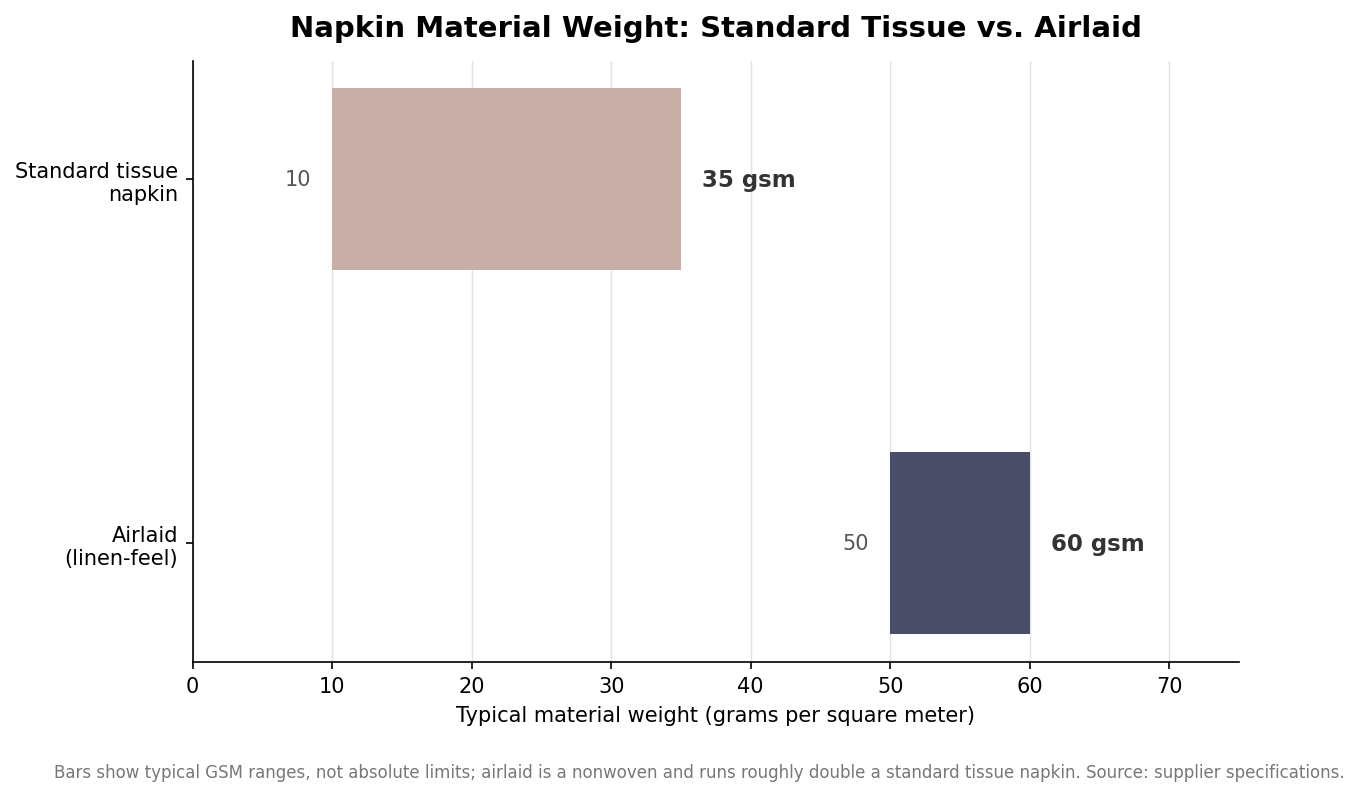
    Floating range bar chart comparing typical GSM weight of standard tissue napkins versus airlaid napkins
    Airlaid napkins typically weigh roughly double a standard tissue napkin per square meter.

    Virgin, recycled, or blended pulp

    Underneath ply and construction sits the fiber source, and it shapes both cost and appearance. Virgin pulp, made from fresh wood fiber, gives the brightest white and the most consistent surface for printing, at the highest resource cost. Recycled pulp lowers that footprint but tends toward a slightly warmer, less uniform base and can accept ink a touch differently. Many stocks split the difference as a semi-virgin blend, balancing brightness, strength, and price. Brighter virgin stock makes fine type and full-color art pop, while a busy or dark design can mask the warmer cast of recycled fiber, so the fiber and the artwork are worth deciding together. Because napkins touch food and mouths, any stock you order should be a food-contact-appropriate grade; and if a compostable or recycled claim matters to your brand, ask the supplier to name the specific certification rather than relying on a generic label, since terms like biodegradable and compostable are not interchangeable.

    How material and print method interact

    The stock you pick also limits how a logo can be applied. Flat printing sits comfortably on almost any tissue or airlaid surface, but the more tactile methods have preferences. Embossing needs enough thickness to hold a raised impression, which is why it reads far better on airlaid or a heavier multi-ply tissue than on a thin single-ply. Foil stamping, likewise, lays down more cleanly on a dense, smooth surface. If a design leans on texture or metallic shine, the material decision effectively gets made first, and the print method follows from it — not the other way around.

    Matching the material to the moment

    Put together, the choice is usually quick. A high-volume bar or coffee counter, where napkins are grabbed by the handful, is a job for economical single- or two-ply tissue at a beverage or luncheon size. A casual restaurant handing out napkins with plated food wants two- or three-ply dinner tissue for the absorbency. A wedding, gala, or brand event where the napkin sits folded on the plate is where airlaid pays for itself, especially paired with embossing or foil. Decide the setting and the level of use first, let that point you to tissue or airlaid, then choose ply, size, and fiber to fit. Ordering in that order keeps both the feel and the budget where you want them.
  • Five Mistakes to Avoid When Ordering Custom Napkins

    Five Mistakes to Avoid When Ordering Custom Napkins

    Custom napkins look like the easiest thing on an event order form, which is exactly why they go wrong so often. The artwork gets approved in a hurry, a size and a print method get picked from a dropdown, and the box arrives holding a thousand napkins that are too thin, too small, or printed in a way that buried the logo. None of these mistakes are exotic. They are the same handful every time, and each one is avoidable if you know to look for it before you approve the order.

    Ordering a size that fights the moment

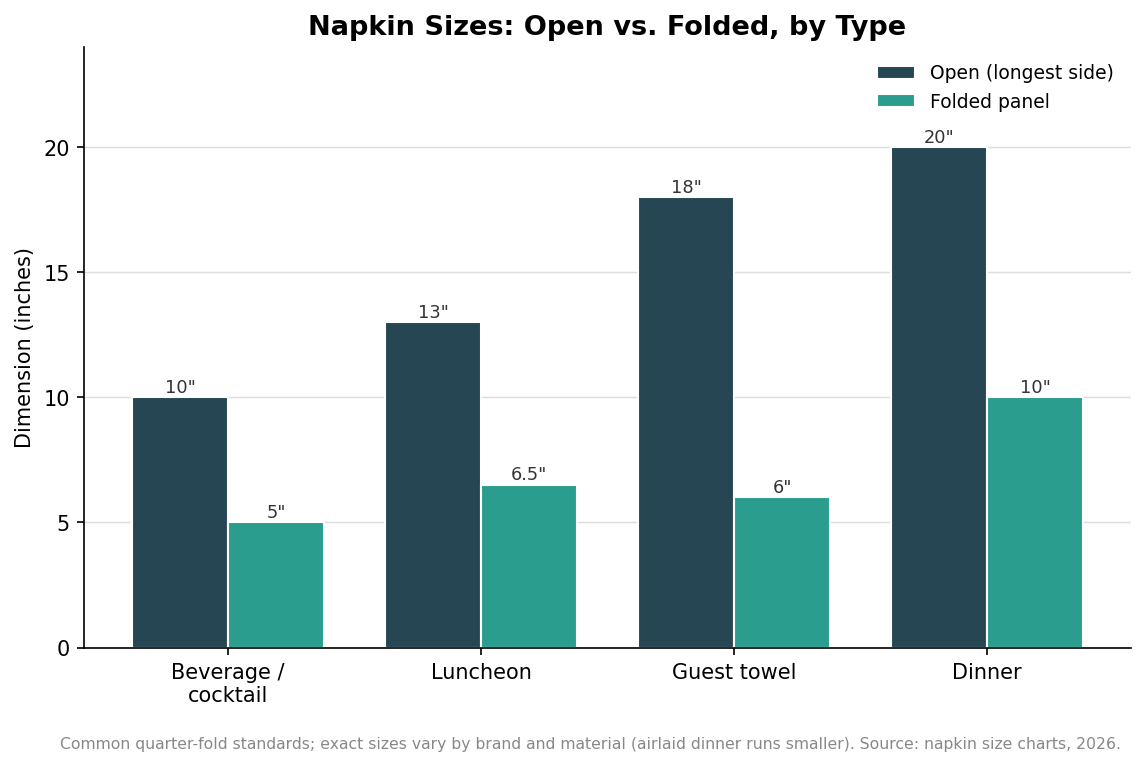
    The most common mistake is matching the napkin to a mental image instead of to how it will actually be used. Napkins come in a few standard sizes, and they are not interchangeable. A beverage or cocktail napkin is about 10 by 10 inches open and folds to a 5 by 5 inch square, sized for holding under a drink or a passed appetizer. A luncheon napkin is roughly 13 by 13 inches open, folding to 6.5 by 6.5. A dinner napkin is the big one, commonly around 20 by 20 inches open and folding to a 10 by 10 panel that covers a lap through a plated meal. Guest towels are a rectangular amenity size near 12 by 18 inches for restrooms and buffets.

    Grouped bar chart comparing open and folded dimensions of beverage, luncheon, guest towel, and dinner napkins in inches
    Standard napkin sizes open versus folded; the folded panel is what guests actually see and use.

    Order cocktail napkins for a seated dinner and guests are dabbing at a full meal with a square barely bigger than a coaster. Order dinner napkins for a stand-up reception with passed bites and you have paid for oversized cloth that guests fold down anyway. Pick the size from the service style first, and remember that exact dimensions vary by brand and material, so confirm the numbers on the actual product rather than assuming.

    Treating ply and material as the same decision

    The second mistake is ignoring what the napkin is made of. Standard paper napkins come in one, two, and three plies of tissue, and they are built for higher-volume everyday service where thin and inexpensive is the point. Airlaid is a different material entirely: a non-woven paper bonded with air rather than water, thicker, softer, and visually close to cloth, which is why it reads as premium and is a favorite for weddings and upscale events. Specify a thin one-ply tissue for a plated dinner with rich food and it disintegrates in hand; pay for airlaid on a high-volume bar giveaway and you have spent a linen-like budget on something guests use once and toss. Match the material to both the food and the impression you are trying to make.

    Picking a print method the artwork cannot use

    Print method is where good logos die. Foil stamping presses a metallic film into the napkin, one color per stamp, and it looks genuinely luxe, especially on a dark or saturated napkin, with a wide range of Pantone-matched foil colors to choose from. Flat ink printing lays down solid spot colors and is clean and economical for a simple one or two-color mark. Full-color digital printing is the only option that reproduces photographs, gradients, and many-colored artwork, and it looks best on white or light airlaid stock. The mistake is sending the wrong artwork to the wrong method: a full-color photographic logo cannot be rendered as a single-color foil, and a pale metallic foil on a light napkin simply disappears. Decide the print method against the actual artwork, not against which one sounds fanciest.

    Designing without the fold and the print area in mind

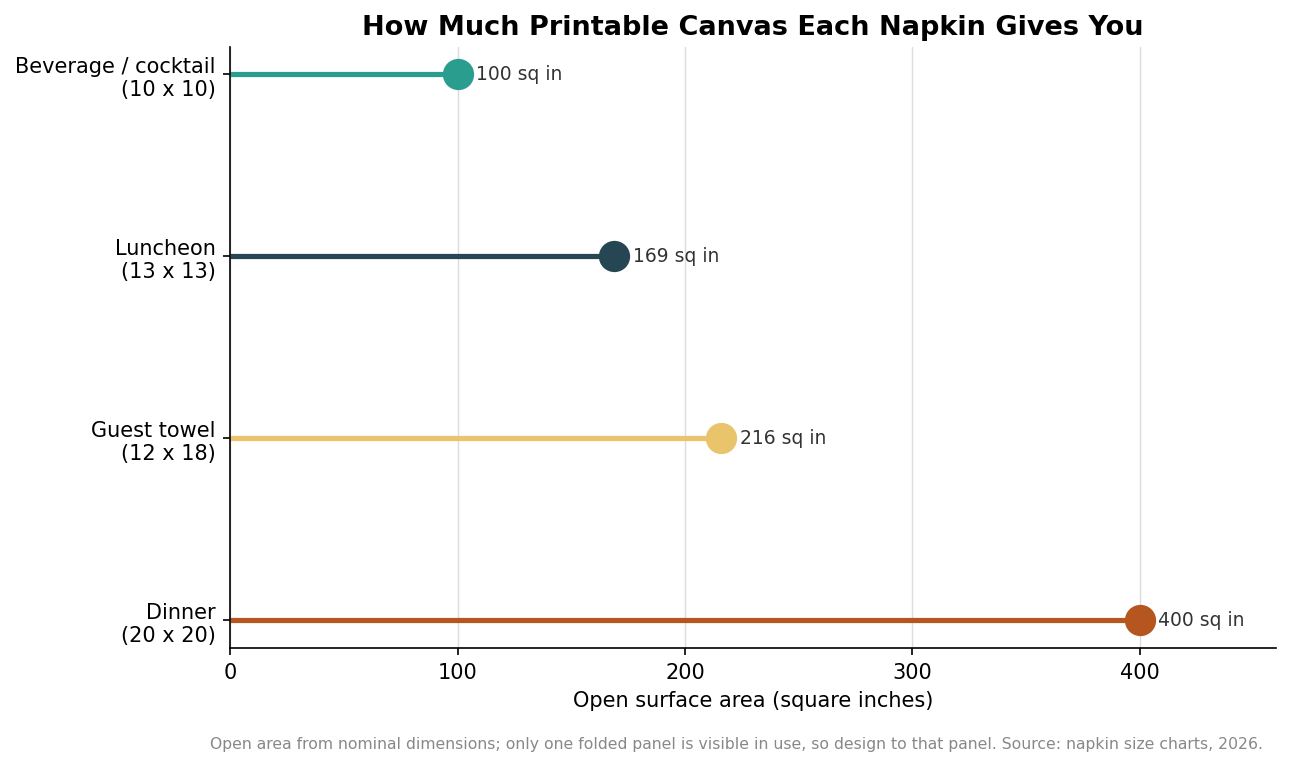
    Even the right size and method fail if the art is laid out for a flat sheet. A napkin is seen folded, so only one quarter panel shows in use, and anything outside that panel is invisible until someone unfolds it. A wide wordmark that looks balanced on the open sheet can run off the visible panel or straddle a fold line once folded. The printable canvas also shrinks dramatically as the napkin gets smaller, which is easy to underestimate.

    Dot plot of open printable surface area in square inches for cocktail, luncheon, guest towel, and dinner napkins
    Open surface area by napkin type; a dinner napkin offers four times the canvas of a cocktail napkin.

    Design to the folded panel, keep the logo centered within a safe margin, and avoid critical detail near the edges and fold lines. On a cocktail napkin especially, a busy logo that works on a business card will be cramped; simplify the mark and give it room. Ask for the printer’s template so the artwork is built to the exact visible area rather than trimmed down later.

    Underestimating quantity and lead time

    The last two mistakes are logistical and they compound. People count one napkin per guest and run out by mid-event, because a guest at a bar goes through two or three over a night. Order a comfortable buffer above head count rather than exactly to it. Timing trips up the rest: standard turnaround at Get Custom Napkins is about 2 weeks after you approve the free mockup, and foil setup plus a proofing round can add to that. Express turnaround is available on request but is not the standard timeline. The minimum order is 12 pieces on any napkin style, but foil carries per-color setup and premium materials raise the floor. Approve the proof early, confirm the quantity with a margin, and let the lead time drive the order date so you are not paying rush fees to fix a calendar you could have planned around.

    None of these are hard to avoid once they are named. Choose the size from the service style, the material from the food and the feel, the print method from the artwork, the layout from the fold, and the quantity and order date from the real timeline. Get those five right and custom napkins go back to being the easy part of the order.

  • How Many Napkins to Order for an Event: A Planning Formula

    Ask ten planners how many napkins an event needs and you will get ten round numbers and a shrug. It is one of the last line items anybody calculates, which is why it is one of the most reliably wrong. Order short and somebody is opening a bag of plain white squares behind the bar at nine o’clock. Order wildly long and you have a storeroom full of a date that has already happened. There is a better method: count the service points, multiply by guests and hours, then add a deliberate overage rather than an accidental one.

    Step one: count service points, not guests

    The single biggest error in napkin planning is treating an event as one number of people. It is not. It is a set of separate service points, each with its own consumption rate, and the same guest passes through several of them in an evening.

    A typical reception has four: the bar, the passed-food service, the seated meal, and the restrooms. A conference has different ones: the coffee break station, the hospitality bar, the boxed lunch. A cafe has exactly one, repeated all day. Write down the service points first and the arithmetic becomes obvious.

    Step two: apply a rate to each one

    These are working planning rates, drawn from how venues actually consume napkins rather than from how many a guest theoretically needs.

    Bar and beverage service

    Plan on 2 to 3 beverage or cocktail napkins per guest for the first hour, and 1.5 per guest for each hour after that. The first hour is always the heaviest because everybody arrives, gets a drink, sets it down and picks up a fresh napkin with the next one. Self-serve bars and stations where guests help themselves run higher — use the top of the range and then some, because people take two.

    Passed food and buffet lines

    Plan on 1.5 to 2 napkins per guest across the whole service, in luncheon size or in guest towels if the food is greasy or handheld. Buffet lines run at the higher end because guests return for a second plate and never reuse the first napkin.

    Seated meals

    Plan on 1.25 dinner napkins per cover. One napkin per seat is the obvious number, and the extra quarter covers the ones dropped on the floor during setup, the replacements a server brings mid-meal, and the covers you add when the final count moves in the last week.

    Restrooms

    Plan on 1.5 to 2 guest towels per guest for an event running three hours or more, and distribute them per restroom rather than as one pile. Guests visit more than once, and the towel by the sink is where a property crest does quiet work.

    Step three: a worked example

    Take a wedding reception: 150 guests, four hours, one hour of cocktails followed by a plated dinner, with restrooms stocked.

    Bar. First hour at 2.5 per guest: 150 × 2.5 = 375. Three further hours at 1.5 per guest per hour: 150 × 1.5 × 3 = 675. Bar total: 1,050 cocktail napkins.

    Passed food during the cocktail hour. 150 × 1.5 = 225 luncheon napkins.

    Seated dinner. 150 × 1.25 = 188 dinner napkins.

    Restrooms. 150 × 1.75 = 263 guest towels.

    Then add an overage of 15 percent on anything served by staff and 25 percent on anything guests take themselves. Applied here, the bar lands near 1,300, passed food near 260, dinner near 216, restrooms near 330. Finally, round each one up to whole packs rather than to a tidy number, because you buy napkins in packs and a half pack does nobody any good.

    Step four: sanity-check the shape of the order

    Look at the four figures side by side before you send them. Two things should be true. The bar number should dwarf everything else — if it does not, you have under-counted the hours. And the dinner number should sit just above your guaranteed cover count, not far above it, because dinner napkins are the one line where a big overage genuinely goes to waste after the date passes.

    If a number looks wrong, the usual culprit is hours. Planners consistently count the printed start and end time rather than the actual span of service, and bar service almost always begins before doors and continues after the last course.

    Ongoing venues: use covers, not events

    If you run a restaurant, cafe or taproom rather than a one-off event, the math flips. Count napkins per cover or per drink from a week of real usage — count what leaves the storeroom, not what you think should — then multiply out to a quarter or a season. Most operators land between 1.5 and 2.5 beverage napkins per drink served, and higher if the napkins live in a self-serve dispenser on the counter.

    Buying a season at a time is normal and sensible. Napkin stock stores well as long as it stays flat, wrapped, off the floor and out of direct sun; damp storerooms are the enemy, because the sheet takes on humidity and the layers feel limp and separate at the fold.

    A few practical notes that save orders

    Order the dated design and the house design together. Venues that print a house napkin for everyday service and a dated version for a specific event place one order, get one delivery, and stage them in separate labeled cartons.

    Plan the calendar backwards. Standard production and delivery takes 2 weeks (faster turnaround available with express shipping), and your free mockup comes back within 24 hours, so a design approved three weeks out is comfortable rather than tight. If the date will not move, say so up front and we schedule from it.

    Send your guest count, service points and hours along with your logo and we will run these numbers with you and lay the artwork out on a free true-size mockup within 24 hours — from a minimum of just 12 pieces.

  • Cocktail, Luncheon or Dinner: Choosing the Right Napkin Size and Ply

    Napkin orders go wrong in the same two places nearly every time. Somebody buys one size for a service that actually needs three, or buys the right size in a weight that gives up halfway through the meal. Both mistakes are easy to avoid, and both come down to knowing what the standard sizes and the common ply weights are genuinely built to do.

    The four sizes, and what each one is really for

    Beverage and cocktail napkins

    Both names describe the same footprint: a sheet that opens to about ten inches square and quarter folds down to a five-inch square. The difference is intent. A beverage napkin is the volume product — two-ply, coil embossed, printed in one or two spot colors, stacked deep in a service well and handed out with every drink that leaves the counter. A cocktail napkin is the same shape treated as an occasion: three-ply, softer in the hand, usually foil stamped or letterpressed, sitting under a coupe glass at a reception.

    The trap here is artwork scale. Five inches sounds generous until you take a quarter inch of safe margin off each edge and remember that the guest is reading it from arm’s length in low light. Wordmarks work. Wordmarks with a tagline and a registered symbol underneath do not.

    Luncheon napkins

    The luncheon napkin opens to roughly thirteen inches square and quarter folds to six and a half. It is the most versatile size in the range, because it is big enough to cover a lap at a seated lunch and small enough not to swallow a place setting or a to-go tray. Cafes, bakeries, banquet lunches, showers and rehearsal dinners run through more of this size than any other. If you are only going to print one napkin for the whole operation, this is usually the one.

    Dinner napkins

    A dinner napkin is the full sheet, around fifteen by seventeen inches open, folded in eighths into a tall rectangle roughly four and a quarter by eight and a half inches. That eighth fold is what makes it a different design problem from everything above it: the visible panel is tall and narrow, which flatters a stacked monogram, a crest or a date and fights a wide horizontal logo lockup. It stands in a ring, lies flat beside a fork, and appears in nearly every photograph anyone takes of the room.

    Guest towels

    Guest towels share the dinner napkin’s tall folded footprint in a much heavier airlaid sheet. They live on a restroom tray, a buffet line or a passed-food station, where tissue simply comes apart.

    Ply: what it actually changes

    Ply is the number of tissue layers bonded together, and it changes three things at once: thickness, absorbency and the way the napkin feels when somebody picks it up.

    Two-ply is the everyday weight. It handles condensation off a cold glass, feeds cleanly through counter dispensers, stacks tightly and is the sensible answer when a case a week leaves the storeroom. Three-ply is thicker, softer and noticeably more absorbent — the right call for sauced menus, long seated meals, and any service where the napkin is part of the table rather than part of the supply chain.

    One point that surprises buyers: absorbency is not purely a function of ply count. Embossing creates air pockets between the layers, and that trapped volume is doing much of the work. A well-embossed two-ply beverage napkin will out-perform a flat, thin three-ply every time. This is also why the embossed edge along the fold matters — it locks the plies together so the napkin does not splay open when a wet glass lands on it.

    Tissue or airlaid?

    Airlaid cellulose is the other material in the range, and it is not simply a heavier paper. It is a non-woven sheet engineered to behave like cloth: it drapes over a lap instead of crumpling, holds a fold, keeps its strength when wet, and will not pill against the rim of a wine glass. Linen-feel napkins add a woven-look texture and a hemstitch-style edge on top of that, and guests routinely fail to notice they are disposable until they pick one up.

    Airlaid also holds finer print detail than tissue. Thin serif type, hairline rules and small engraved crests survive at size on airlaid and thicken up or fill in on soft tissue. If your brand lives on delicate typography, that alone can decide the material.

    Matching the size to the way you actually serve

    Work backwards from the service, not from the catalog. A bar with no food needs one size, in volume, in the cheapest weight that still looks right. A cocktail hour that rolls into a plated dinner needs two: five-inch squares at the bar and eighth-folded dinner napkins at the covers, both carrying the same mark so the room reads as one thing. A venue with restrooms worth noticing adds guest towels as a third line. A cafe with a pastry case and a lunch menu can genuinely get away with a single luncheon size for everything.

    A starting spec you can reuse

    For a venue running a bar and a seated service: three-ply cocktail squares in your stock color with a simplified foil mark for the bar, three-ply dinner napkins in eighth fold with the same mark rebuilt as a tall stacked lockup for the tables, and airlaid guest towels carrying that mark for the restrooms. For a cafe or a taproom: two-ply beverage napkins, coil embossed, one spot color, kraft or white, ordered by the case.

    Both marks come from a single approved artwork file, which is the part that pays off later — every reorder pulls from it, so the run you place next spring comes back identical to this one. Send your logo and rough quantities and our designers will lay the whole set out on a free true-size mockup within 24 hours, from a minimum of just 12 pieces.

  • Foil Stamping, Flat Printing or Embossing: How to Put a Logo on a Napkin

    A napkin is a difficult surface to print on. It is soft, absorbent, folded into layers, and it is looked at for about three seconds at a time in lighting nobody chose for reading. The three decoration methods available — hot-foil stamping, flat printing and embossing — are not three settings on the same machine. They are genuinely different processes that solve that problem in different ways, and choosing between them is the single decision that most affects whether your mark actually reads at the table.

    Hot-foil stamping

    Foil stamping uses a heated metal die to press a thin metallic film onto the sheet. The film releases where the die touches and nowhere else, so the edge is defined by tooling rather than by ink spreading into fibers. That is the whole reason foil works so well on an absorbent stock: nothing soaks in, nothing feathers, and the mark sits crisp and opaque on a surface that would blur a fine ink line.

    It is also the brightest option by a wide margin. A metallic mark catches whatever light is in the room and bounces it back, which is why foil is the default for bars, receptions and any setting where the light level is deliberately low.

    The limitations are worth knowing up front. Foil is chosen from a range of finished films rather than mixed to a formula, so it can get very close to a brand color without landing exactly on it. Very fine hairlines and small counters — the enclosed spaces inside letters like “a” and “e” — can fill in when the die presses into soft tissue, so artwork usually wants thickening slightly before it goes to a die. And foil is a single flat layer: no gradients, no photographs, no tonal shading.

    Flat printing

    Flat printing puts ink on the surface, and it splits into two families that suit very different orders.

    Spot color printing

    One or two spot colors run at speed is how high-volume napkins are decorated. The ink is mixed to your color, the press runs fast, and a bold logo comes off clean at case quantities. This is the right answer for a taproom, a coffee bar, a concession stand or any operation where napkins are a weekly consumable rather than an event item. Each additional color adds a station and a setup, so a two-color maximum keeps volume runs simple.

    Full-color digital printing

    Digital printing carries anything: photographs, gradients, watercolor illustration, complex multi-color artwork. There is no per-color setup, which makes it the natural fit for shorter runs and for designs that would be impossible any other way. The trade-off is that ink on absorbent stock always softens slightly compared with the same file on coated paper or a backlit screen. Colors read a touch quieter, and very light tints can disappear into a warm stock. It is predictable, and we call it out on the proof rather than letting anyone discover it in the carton.

    Embossing and blind debossing

    Embossing presses the shape into the sheet itself using a die and a counter-die, so the image is made of raised or recessed material rather than pigment. Run with no ink or foil at all, it becomes a blind deboss: your crest pressed into ivory stock, visible only as a change in surface and shadow.

    It is the quietest option and, oddly, the one people describe as the most expensive-looking. Weddings, private clubs and hotels use it constantly for exactly that reason.

    Embossing is unforgiving about artwork. It reproduces shape, not detail. A monogram, a crest, a simple wordmark or a heavy line drawing will emboss beautifully. A logo with thin strokes, small type or tight interior detail will come back as a vague texture. Depth also depends on the stock: airlaid and heavier three-ply sheets hold a crisp emboss, while a light two-ply will flatten out again over time in the pack.

    How to choose in about a minute

    Start with the light. If the napkin lives in a dim bar or an evening reception, foil wins before any other consideration, because it is the only method that generates its own contrast.

    Then look at your artwork. Photographic, gradient or more than two colors sends you to digital, with no real argument. One or two flat colors at case volume sends you to spot printing. A simple, bold, self-contained shape gives you a genuine choice between all three.

    Then look at the stock. On dark stock, foil and opaque white ink are the only things that reliably read; a dark spot color on black is invisible from two feet away. On unbleached kraft, pale inks lose contrast fast, so dark ink or foil is the safer call. On ivory, a blind deboss is at its best.

    Preparing artwork that survives any of them

    Send vector art if you have it — AI, EPS, PDF or SVG. High-resolution raster files work too, and our designers redraw low-resolution logos free rather than printing something soft. Keep the design a quarter inch clear of every folded edge, because napkin stock shifts slightly as it feeds and folds, and artwork pushed into a corner can end up trimmed unevenly or wrapped around a fold where nobody sees it.

    Above all, simplify before you shrink. The instinct when a logo does not fit is to scale it down; the correct move is almost always to remove elements — drop the tagline, thicken the hairlines, and let the wordmark carry it. A napkin has one job as a printed surface, and it does that job at arm’s length in three seconds.

    Send your logo and tell us where the napkin is going to live. We will recommend a method, show it on a free true-size mockup within 24 hours with the fold lines and safe area drawn in, and revise it as many times as you need before anything goes on press — from a minimum of just 12 pieces.